

Project
EV.BUDDY
Overview
A New EV Charging
Mobility Service
Robotics
2024
EV.BUDDY is an autonomous electric vehicle charging service designed to bridge the transition from internal combustion engines to electric vehicles. Unlike traditional wired and fixed wireless chargers, EV.BUDDY autonomously moves to charge parked vehicles, enhancing charging efficiency and supporting the coexistence of both vehicle types.
Index
Part 1. Strategic Context
01 Macro Context
02 Defining the Problem
03 Market Analysis
04 Financial Critical Mass
05 Utility Revenue Architecture
06 Structural Domain Classification
Part 3. Engineering Details
12 Drive System
13 Safety Interaction
14 Continuous Relational Dispatch
15 Adaptive Lifting System
16 Station System
Part 2. Design Management
07 Optimal Market Timing
08 Design Management Solution
09 Paradigm Shift in EV Charging
10 Brand Identity System
11 Digital Interaction Architecture
Part 4. Business Impact
17 Market Penetration Strategy
Part 1. Strategic Context
01 Macro Context
Infrastructure Scale
& Commercial Demand
The global EV charging infrastructure market was projected to grow at a CAGR of 41.8% from 2018 to 2023, with Asia-Pacific expanding from $33.70B to $197.05B. This growth centers on rising demand for commercial DC fast-charging systems for public facilities.

02 Defining the Problem
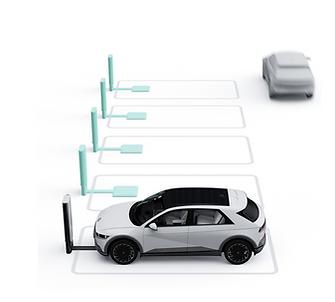
Like smartphones, EV charging systems are shifting from wired to wireless.
However, even promising stationary wireless systems still face the physical limitations of being fixed
in place, so not all charging-related challenges can be fully addressed.
Physical Limits
of Stationary Charging



Problem 01
Economic
Feasibility
Wired and wireless charging station
installation costs vary widely based on
parking space characteristics, resulting
in economic inefficiency.
Problem 02
Charging
Efficiency
Misaligned vehicle and charging pad
can lead to incomplete charging,
causing payment inaccuracies.
Problem 03
Parking
Flow
In fixed charging stations, competition
for slots exists. Even after one vehicle
finishes charging, if it doesn't move,
others can't charge.
03 Market Analysis
Operational Tradeoffs
& Unmet Needs
Analyzing current market cases reveals clear operational trade-offs for each charging method. Ceiling-mounted systems use ground space well but require
heavy renovation and high initial costs, while delivery-based services can cause congestion due to their bulky size and carry high fees. Fixed wired lines and
trunk-stored portable chargers fail to free users from cable hassles and spatial constraints. These gaps point to the need for non-invasive, wireless charging
mobility that operates beneath vehicles without occupying valuable space.


02
Ceiling-Mounted Charging
Easy for users to choose options like fast or slow charging
Relatively higher safety compared to other charging methods
Requires an existing ceiling structure for installation
High installation costs
Requires an existing ceiling structure for installation
High installation costs
05
Mobile/Portable Charging
Can be easily charged using a standard outlet.
Small size allows for easy storage in a trunk or bag
Charging is only possible near an outlet
There are limitations on charging speed
06
Cart-Type Charging
Fewer restrictions on charging locations
High installation costs
Large size may cause issues such as blocking pathways
Fails to escape the hassle of plugging and unplugging
03
Mobile Charging Service
Monthly subscription model allows
overnight charging, eliminating time
and space constraints.
High usage fees create
a financial burden for users.
04
Wireless Pad Charging
Users are free from plugs
Charging efficiency drops if the parking alignment is incorrect
Lower energy efficiency and power loss compared to wired charging
01
Stationary Charging
Easy for users to choose options like fast or slow charging
Relatively higher safety compared to other charging methods
Hassle of handling heavy, dirty cables daily
Requires users to drive to a designated charging area
04 Financial Critical Mass
Market
Prerequisites
According to Deloitte Insights, a new charging platform must surpass a "Critical Mass" of 5% fleet penetration to achieve commercial profitability. This inflection point drives down hardware costs, making high-end equipment profitable. To survive this pre-revenue phase and secure a market position, a strategy combining robust capital with strong industry partnerships is essential. Consequently, the initial phase must be defined not as a simple product sale, but as a long-term infrastructure investment backed by substantial capital and strategic alliances.
Critical Mass for
Full-Scale
Commercial Profitability
:
5% of Total Vehicle Fleet or 2.0M Units
The report projected this inflection point for the mid-2020s,
with optimistic scenarios placing it after 2023.
2.6 M
7.0 M

2.6 M
Conservative
7.0 M
Base-Case
10.6 M
High-Case
"Considering that profitability may only materialize post-2023, the most successful new entrants will be those backed by robust
capital, powerful partnerships, or ideally, both."
EV Adoption Rate: Advanced Market Milestone
Source: "EV Charging Stations and Market Opportunity Analysis,"
Justine Bornstein & Tom Bain, Deloitte Insights.
05 Utility Revenue Architecture
Future Charging
Optimization
Unlike the residential-focused slow (AC) charging segment, commercial districts and urban destination facilities are expected to shift toward ultra-fast direct current (DC) charging.
While high hardware and grid maintenance costs present barriers, DC fast-charging infrastructure enables a premium business model with higher retail rates per kW based on speed. In other words, even with low utilization, high unit margins per slot are achievable. This implies that next-generation charging solutions must incorporate high-power fast- charging specs to secure early commercial profitability.

Low Cost
Slow Speed
High Penetration
The Leading Charging Types of the Future
High Cost
Fast Speed
High Profitability
7.0 M
AC Charging
Accounting for 90% of global infrastructure,
AC charging has widely expanded due to low installation costs, yet it remains fundamentally limited by its slow charging speed.
AC Charging
Accounting for 90% of global infrastructure,
AC charging has widely expanded due to low installation costs, yet it remains fundamentally limited by its slow charging speed.
06 Structural Domain Classification
Need for Versatile Wearable Devices
Supporting Multiple Tasks
Public charging stations in urban hubs are essential for EV drivers lacking residential parking and those needing top-ups on the go. Destination sites like public lots and commercial venues offer the ideal environment, where vehicles typically remain parked for over an hour.
For commercial operators, this infrastructure serves as a powerful incentive, encouraging customers
to stay and consume retail services during charging cycles, thereby unlocking new revenue streams.

MAIN BM

Home Charging
Commercial Venue
Charging
Depot Charging
On-Road Charging
Part 2. Design Management
07 Optimal Market Timing
An Ideal Segment for
Future Use
The proposed system is most effective from the late 2020s through the 2030s, when the economic feasibility and efficiency of stationary wireless charging pads are steadily improving. It can also continue to provide service in areas where charging infrastructure is lacking or stationary charging remains inefficient, serving as a flexible bridge in the transitional phase of EV charging systems.
Equipped Professional

Time
Late 2020s
Present
2030s
After 2030
EV Charging
Business Profitability
Electric Vehicle
Ratio
Wireless Charging
Pad Efficiency
Source:
MarketsandMarkets
Electric Vehicle Charging Stations Market, 2018
08 Design Management Solution
Mobile Infrastructure:
Driving Premium Value
via On-Site Convenience
The non-invasive, add-on design avoids large-scale grid construction by delivering high-power charging directly to parked vehicles through on-site mobility. Because users are willing to pay a premium for this time-saving convenience, the model supports a higher retail rate per kW. Consequently, even with low
initial utilization, high unit margins support early commercial viability and improve parking flow during
the transition period.

02
Auto Alignment for
Optimal Charging Efficiency
01
Cost & Charging Management Efficiency
with Single Platform Installation
03
Optimal Parking Space Flow Management
Through Dedicated App and Kiosk Systems


09 Paradigm Shift in EV Charging
Autonomous, Flexible Charging
through a New EV Mobility Service
This service presents a shift from fixed infrastructure to flexible, on-site mobility. By avoiding fixed constraints and high installation costs, it introduces a new alternative for transitional parking environments. Instead of competing on price, the autonomous system uses premium convenience to maximize space efficiency and sustain a high-margin business.

Fixed
Constraint


The New Alternative
Price
Competition
Premium Convenience
10 Brand Identity System
Intuitive Identity
& Visual System
Color & Typo

이브이.버디
The brand identity combines intuitive naming with a futuristic design system. The name EV.BUDDY directly conveys its core purpose as a friendly companion for electric vehicles, bridging the gap between users and technology. Together with a curated color palette and clear typography, the identity establishes
a recognizable visual presence that supports a trustworthy mobility experience.
EV.BUDDY BLUE

EV.BUDDY CYAN
C
M
Y
K
70
10
0
0
R
G
B
0
174
255
# 00AEFF
EV.BUDDY WHITE
C
M
Y
K
70
10
0
0
R
G
B
0
174
255
# 00AEFF
C
M
Y
K
0
0
0
0
R
G
B
255
255
255
# FFFFFF


ENG.
ABCDEFGHIJKLMNOPQRSTUVWXYZ
abcdefghijklmnopqrstuvwxyz
1234567890.,!?$₩%#*
Ultra Light
Light
Regular
Bold
NanumBarunGothic
Mobility
Electric Vehicle
Charging Service
KOR.
가나다라마바사아자차카타파하
1234567890.,!?$₩%#*
울트라 라이트
라이트
레귤러
볼드
나눔바른고딕
모빌리티
전기차 충전
서비스
11 Digital Interaction Architecture
Streamlined
Digital User Journey
The mobile interface streamlines the entire process into an intuitive four-step flow, providing easy access to on-demand charging.

01
Setting Location via
Map Search
On the main screen map, you
can directly select a service
location or search for your
desired service location.

02
Setting Location via
Map Search
On the main screen map, you
can directly select a service
location or search for your
desired service location.
03
Setting Vehicle
Information
Select the vehicle type and
enter the license plate and
parking location to set
alignment values.
04
Setting Location via
Map Search
Select a payment method,
complete the payment, and
receive a notification once
charging is done.
Part 3. Engineering Details
10 Biomechanical Kinematics
Dynamic Movement
in Restricted Spaces
EV.BUDDY is equipped with Mecanum wheels, enabling omnidirectional movement and efficient charging by automatically aligning with various parking positions, including tight spaces.

Due to the low height of the product, there's a risk that drivers or
pedestrians may not notice EV.BUDDY. To prevent this, EV.BUDDY is
equipped with rear signal lights that are raised approximately 90 degrees,
alerting pedestrians and vehicles in the vicinity to its presence.
13 Safety Interaction
High-Visibility
Safety Signaling
14 Continuous Relational Dispatch
Uninterrupted
Charging Cycle
The central platform monitors each unit's energy level in real time. If an active EV.BUDDY needs to recharge before reaching the target charge, the system dispatches a secondary unit to take over, maintaining an uninterrupted, automated charging cycle.
Because underbody height varies across electric vehicles, the battery compartment lifts to achieve proper charging alignment. Sensors on top measure the height, and a space-efficient lift mechanism adjusts accordingly.
15 Adaptive Lifting System
Lifting Based on
Vehicle Height

50 %
Optimal EV.BUDDY
for Each Situation
Electric Vehicle
Charging Status
Station Return Due to
Power Shortage
100 %
10 %
16 Station System
A Station for
Flexible Parking Flow
The EV.BUDDY station houses 5 main units and storage for 4 spare batteries. It features racks for both the main units and batteries, equipped with lifts and belts for smooth movement. Batteries are inserted into the main units using suction cups.
EV.BUDDY allows charging remotely using a smartphone, but for first-time
users or those hesitant to install the app, there's a kiosk screen on the front
of the station.

Using Suction to Grip the Battery
and Move It to the Replacement Slot
Picking Up Batteries from
the Battery Storage Rack
Battery Insertion into
Fully Charged EV.BUDDY Units
Relocated EV.BUDDY Units
Moved to Replacement Slots
Lifting Stored
EV.BUDDY Units
4
1
2
5
3
Part 4. Business Impact
17 Market Penetration Strategy
Strategic Partnership
Roadmap Based on Industry Synergy
Based on market research, the EV charging ecosystem is attracting diverse players, yet significant operational and technical gaps remain. The primary business model focuses on automotive OEMs and robotics enterprises, as they meet the key criteria for strategy, execution, and technology. EV.BUDDY serves as a high-margin alternative that merges automotive networks with robotic automation, creating mutual business value.


Energy
Companies
Industrial
Goods
Companies
Independent
Enterprises
Oil & Gas
Companies

Automotive
OEMs
Robotics
Enterprises
Strategyies
Execution
Technical
Factors
External
Factors
• Clearly defined primary target markets and
segmentation
• Financial viability and long-term funding security
• Clear revenue and service business model
• Proven organizational capabilities for strategic
execution
• Aligned ownership and governance with partners
• Specialized team for charger installation, operation,
and maintenance
• Availability of necessary supporting equipment
• Readiness for core future technologies and assets
• Regulatory compliance and local government
approvals
• Adherence to industry standards and criteria
●
●
●
●
●
◐
◐
○
●
●
◐
◐
○
◐
○
○
●
●
○
◐
Source: "EV Charging Stations and Market Opportunity Analysis,"
Justine Bornstein & Tom Bain, Deloitte Insights.


DONG JU LEE
Design Portfolio
DONG JU LEE
Design Portfolio.© All Rights Reserved by DongJu Lee