
Project
GAP Lamp
Overview
Soft light filtering
through the traditional
gaps of Hanok
Living
2021
This project reinterprets ‘Gojae’, aged wood traditionally used in Hanok, into a modern material with
commercial value. Gojae is a living material that has endured time. Cracks and knots form naturally depending on the surrounding environment. In the past, it was valued only for its structural role. This project transforms the idea of gaps into a unique design language. By reflecting the subtle and gentle sentiment of Hanok, the design evokes the warmth and intimacy of a small traditional house.
Index
Part 1. Strategic Context
01 Macro Context
02 Business Verification
03 Field Research
04 Statistical Backing of Ergonomic Strain
05 Market & Competitor Analysis
Part 3. Engineering Details
10 Biomechanical Kinematics
11 Mechanical Actuation
12 Digital Interaction Architecture
13 Autonomous Wearable Usability
Part 2. Design Management
06 Brand Guide System
07 Design Management Solution
08 User Experience Strategy
09 Hardware governance
Part 4. Business Impact
14 Market Penetration Strategy
Part 1. Strategic Context
01 Macro Context
Social Demand &
Inevitable Wearables

Fixed Automation


24/7 high-volume output and
maximum precision.
Prohibitive costs and
severe spatial limitations.
Stricter legal regulations on industrial accidents have sharply increased corporate liability for worker safety. Traditional automation faces critical spatial and financial constraints, leaving core manufacturing processes reliant on human labor. To bridge this market gap, a wearable robot product line was planned preemptively providing immediate physical support while establishing a scalable technology infrastructure for future defense and healthcare sectors.

Humanoid
High mobility and zero labor risk.
Sub-standard field speed and
excessive R&D costs.

Wearables
Zero infrastructure costs
and disruptively low pricing.
Needs customization for
diverse user body sizes.
02 Business Verification
Exclusive Securing of Enterprise
Test-beds and Monetization


To capitalize on surging social demand, the business strategically targets high-growth sectors: logistics, manufacturing, and healthcare. Concurrently with product planning, test-beds were secured in collaboration with global brands, specifically LG Electronics (Changwon Smart Park) and CJ Logistics (Yangsan Logistics Center). This alignment ensures high research credibility and establishes a practical B2B revenue model through customized suit supplies.
03 Field Research
Identifying Process
Diversification & Structural Risks
Conducted ergonomic and musculoskeletal risk assessments through direct site visits to enterprise test-
beds. Deep analysis of actual field data revealed that working environments vary completely by industry. Furthermore, task types and physical workloads are highly diversified even within the same site, establishing concrete, data-driven design requirements.

Repetitive motion
MMH
Excessive force
Unnatural posture
Other factors
Unclassifiable

0 %
20%
40%
60%
Head, Neck
Shoulder
Arm, Elbow
Hands, Fingers
Waist
Legs, Feet
Source: Korea Occupational Safety and Health Agency
04 Statistical Backing of Ergonomic Strain
Need for Versatile Wearable Devices
Supporting Multiple Tasks
Industrial work environments vary widely, but existing wearable devices fail to adapt flexibly. Since real-world manufacturing tasks involve complex, combined movements, single-motion assistive devices have strictly limited effectiveness. Statistical data validates the urgent need for versatile solutions that support multiple tasks simultaneously.
05 Market & Competitor Analysis
Maturing Market
Absent Standard
Cross-analysis of the global market indicates that leading enterprises such as Ekso Bionics, Comau, and Ottobock are entering the wearable robotics sector.However, no competitor has yet established a definitive standard capable of adapting flexibly to diverse work environments and worker traits.
Despite entering a maturing phase driven by government investment, a significant gap remains open for market leadership.
Heavy
High Cost
High adaptability
(Flexible, Custom Size, Tool-less)
German Bionic CrayX
Lower Back / Spine
$1,925
4.3 kg

Ottobock Shoulder
Upper Arms / Shoulder
$5,130
1.8 kg

Levitate Technologies
AIRFRAME
Upper Arms / Shoulder
$ 4,500
2.5 kg

Hyundai Rotem VEX
Lower Back / Spine
$2,565
2.6 kg

Hilti EXO-O1
Upper Arms / Shoulder
$1,800
1.9 kg

Laevo flex
Lower Back / Spine
$1,925
4.3 kg

Hyundai Rotem VEX
Upper Arms / Shoulder
$2,885
2.8 kg

SuitX BackX
Lower Back / Hip
$4,000
3.2 kg
Ekso Bionics EVO
Upper Arms / Shoulder
$ 1,800
3.0 kg
Light
Affordable

Mawashi UPRISE
Full Body / Spine
$12,000
5.5 kg

Panasonic ATOUN
Lower Back / Spine
$4,490
4.5 kg

Comau MATE
Upper Arms / Shoulder
$2,565
4.0 kg

INNOPHYS Every
Lower Back / Spine
$1,550
3.8 kg
INNOPHYS GS-ARM
Upper Arms / Shoulder
$1,025
3.2 kg


Auxivo LiftSuit
Lower Back / Hip (Apparel)
$1,400
0.9 kg

Crimson Dynamics
CDYB-Fit
Lower Back / Hip (Apparel)
$1,100
0.85 kg


Low adaptability
(Fixed Size, Requires Tools)
Part 2. Design Management
06 Brand Guide System
‘Rectuo’
From Rectangle to O
Brand
GEAR
Code
Version
B10
Brand Name
MEDI
GEAR
SUIT
FIT
⋮
Body Part Code
B
S
W
H
⋮
Assisted Part
Back
Shoulder
Wrist
Hand
⋮
Version
10
20
30
40
⋮
To resolve the structural fragmentation across different product lines, this stage delivers a unified brand identity driven by the sculptural concept of ‘Rectuo’. This concept, where a rectangle transforms into a circular "O" shape, symbolizes the blending of contrasting concepts such as ‘human vs. robot’ and
‘emotion vs. reason’. Ultimately, this consolidated design DNA systematically unifies disparate mechanical lines, establishing a cohesive and premium Brand Look & Feel across the entire Angel Robotics product family.

Advanced, professional Innovative, ahead of the times

Friendly, fashionable
Fun, human warmth
MEDI
GEAR
FIT
SUIT
07 Design Management Solution
'Modular Platform' to Overcome
High-Mix Low-Volume Production
To fill this market gap, diversifying the product lineup was essential. However, unchecked customization causes critical disadvantages for startups, such as rising costs and inventory failures. To resolve this,
a modular platform architecture was proposed, standardizing core components while allowing functional
modules to be combined. This established a strategy that balances productivity with tailored customization for enterprises.


08 User Experience Strategy
A Modular Uniform for
Empowerment and Pride
angel GEAR is a modular wearable system designed to empower warehouse workers, elevating their role from manual labor to equipped, professional work. By combining ergonomic physical support with
a standardized modular uniform, the system fosters a sense of ownership, confidence, and occupational
pride while adapting to diverse task environments.

Manual
Labor
Passive Routine


Equipped Professional
Ownership
& Pride
09 Hardware Governance
Modular Governance
& Field Usability for
Scalable Deployment
To reduce the cost and quality burdens of high-mix, low-volume hardware production, core components—including the upper hardshell, carbon pipes,
and joint sockets—were unified into a single standardized platform across the entire product lineup (S10, B10, BS10, Soft B10). In parallel, a compact foldable architecture was engineered to maximize on-site storage density and transport efficiency in confined warehouse environments.
This integrated approach allows enterprises to scale fleet deployment with minimal tooling investment while significantly reducing operational friction for field managers and workers alike.

S10
Shoulder and Arm Support
B10
Back Support
BS10
Shoulder & Back Support
Soft B10
Back Support
Part 3. Engineering Details
10 Biomechanical Kinematics
Support for
Sustained Postures
This stage defines the kinematic criteria to minimize musculoskeletal strain during repetitive tasks.
S10 provides targeted assistance to maintain stability during continuous overhead work with raised
shoulders, while B10 delivers supportive torque when bending at the waist for extended periods, helping
users maintain proper posture and work more efficiently.

S10
Highest Motion Point &
Sustained Force
B10
Lowest Motion Point &
Sustained Support
S10 for Sustained Posture
with Raised Shoulders
B10 for Sustained Bending
at the Waist
11 Mechanical Actuation
No Charging
Non-Powered Suit
To eliminate operational downtime and charging infrastructure costs,
a high- efficiency non-powered spring-elastic structure is integrated. S10 offers three adjustable tension levels with a torque range of 38–80 kgf·cm. B10 provides strong support of around 347 kgf·cm, while Soft B10 comes in Mild (~180) and Strong (~270) variations to accommodate diverse work intensities.
An optional sensor module, powered separately from the non-powered suit, tracks physical micro-movements, fatigue indicators, and joint angles.
This physical load data is integrated into a multi-tiered management platform. While on-site workers monitor personal safety thresholds via mobile, field managers use a centralized tablet dashboard to oversee real-time worker fatigue, optimize shift rotations, and help reduce the risk of musculoskeletal injuries across the facility.
12 Digital Interaction Architecture
Data Driven
Workstation
Ecosystem

S10’s Spring Elastic
Body Structure
B10’s Spring Elastic
Body Structure
Soft B10’s Band Elastic
Body Structure
Field Manager
Enterprise Fleet &
Safety Dashboard
On-site Worker
Personal Fatigue &
Safety Status
13 Independent Wearable Usability
Intuitive Donning for
Field Independence
To maximize field accessibility and user independence, the wearable interface is designed for rapid, intuitive donning and doffing. Fastening points use durable, easy-to-use hook-and-loop straps and clips, allowing immediate fine-tuning after fastening and significantly improving comfort and fit without external assistance.

Adjust and fasten
the chest strap.
Fasten both arm straps.
Fasten the clips
on both sides.
Adjust the shoulder straps
for a secure fit.
Adjust the pelvic pad
to your height.
Adjust and fasten
the chest strap.
Fasten both thigh straps.
Adjust the shoulder straps
for a secure fit.
Adjust and fasten
the chest strap.
Adjust and fasten
the side strap.
Fasten both thigh straps.
Adjust the waist straps
for a secure fit.
S10
B10
Soft B10
Part 4. Business Impact
14 Market Penetration Strategy
Data Driven
Commercialization Architecture
To establish long-term financial viability, this project implements a continuous business pipeline driven by pragmatic site data. By initiating direct B2B partnerships with tier-one enterprises, the system conducts advanced process diagnostics to capture raw environmental and ergonomic data. This site intelligence is then leveraged as scalable R&D assets to deliver cost-effective, semi-customized solutions for small-to-mid-tier markets through strategic distributor networks, significantly reducing development overhead and accelerating the path to break-even.
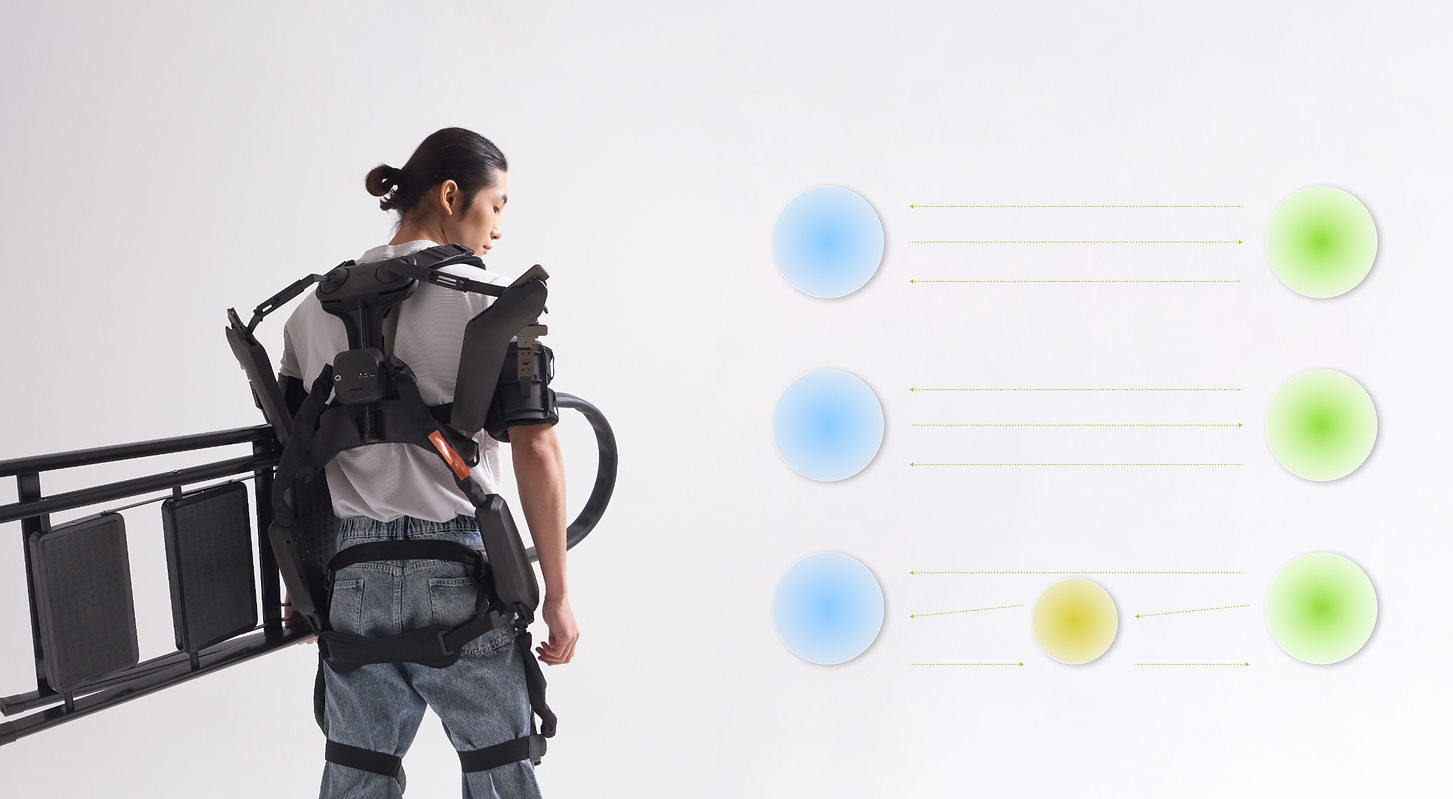
01 Process analysis request from client enterprises
(Logistics/Manufacturing/Hospitals, etc.)
02 Product development and sales based on analysis targeting conglomerates
(pilot markets with strong brand power)
Fee Payment or Development Commission
Analysis & Improvement Proposal
Request for process (hazardous factor) analysis
angel
robotics
angel
robotics
angel
robotics
Client Companies
Client Companies
Client Companies
Intermediate
Distributor
& Retailer
03 For SMEs (fewer than 50 employees), providing customized suits
based on working environment data secured from pilot markets
Custom Suit Production & Validation
Payment for customized suit
Request for product development based on analysis results
Request for product development based on analysis results
Custom Suit Payment
Custom Suit Payment
(Margin Agreement)
Custom Production & Sales
Custom Production & Sales


An Exoskeleton for Industrial Safety
Available at
angel GEAR
Featured at
ZDNET Korea
K-health
Robot News
Red Dot Award
iF Design Award
DONG JU LEE
Design Portfolio.
© All Rights Reserved by DongJu Lee.
DONG JU LEE
Design Portfolio
DONG JU LEE
Design Portfolio.© All Rights Reserved by DongJu Lee