

Project
EV.BUDDY
Overview
A New EV Charging
Mobility Service
Robotics
2024
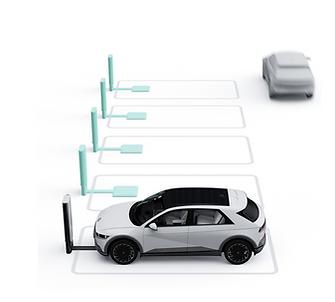
EV.BUDDY is an autonomous electric vehicle charging service designed to bridge the transition from internal combustion engines to electric vehicles. Unlike traditional wired and fixed wireless chargers, EV.BUDDY autonomously moves to charge parked vehicles, enhancing charging efficiency and supporting the coexistence of both vehicle types.
Index
Part 1. Strategic Context
01 Macro Context
02 Defining the Problem
03 Market Analysis
04 Financial Critical Mass
05 Utility Revenue Architecture
06 Structural Domain Classification
Part 3. Engineering Details
12 Drive System
13 Safety Interaction
14 Continuous Relational Dispatch
15 Adaptive Lifting System
16 Station System
Part 2. Design Management
07 Optimal Market Timing
08 Design Management Solution
09 Paradigm Shift in EV Charging
10 Brand Identity System
11 Digital Interaction Architecture
Part 4. Business Impact
17 Market Penetration Strategy
Part 1. Strategic Context
01 Macro Context
Infrastructure Scale
& Commercial Demand
The global EV charging infrastructure market was projected to grow at a CAGR of 41.8% from 2018 to 2023, with Asia-Pacific expanding from $33.70B to $197.05B. This growth centers on rising demand for commercial DC fast-charging systems for public facilities.

02 Defining the Problem
Physical Limits
of Stationary Charging
Like smartphones, EV charging systems are shifting from wired to wireless.
However, even promising stationary wireless systems still face the physical limitations of being fixed
in place, so not all charging-related challenges can be fully addressed.



Problem 01
Economic
Feasibility
Wired and wireless charging station
installation costs vary widely based on
parking space characteristics, resulting
in economic inefficiency.
Problem 02
Charging
Efficiency
Misaligned vehicle and charging pad
can lead to incomplete charging,
causing payment inaccuracies.
Problem 03
Parking
Flow
In fixed charging stations, competition
for slots exists. Even after one vehicle
finishes charging, if it doesn't move,
others can't charge.
03 Market Analysis
Operational Tradeoffs
& Unmet Needs
Analyzing current market cases reveals clear operational trade-offs for each charging method. Ceiling-mounted systems use ground space well but require
heavy renovation and high initial costs, while delivery-based services can cause congestion due to their bulky size and carry high fees. Fixed wired lines and
trunk-stored portable chargers fail to free users from cable hassles and spatial constraints. These gaps point to the need for non-invasive, wireless charging
mobility that operates beneath vehicles without occupying valuable space.


02
Ceiling-Mounted Charging
Easy for users to choose options like fast or slow charging
Relatively higher safety compared to other charging methods
Requires an existing ceiling structure for installation
High installation costs
Requires an existing ceiling structure for installation
High installation costs
05
Mobile/Portable Charging
Can be easily charged using a standard outlet.
Small size allows for easy storage in a trunk or bag
Charging is only possible near an outlet
There are limitations on charging speed
06
Cart-Type Charging
Fewer restrictions on charging locations
High installation costs
Large size may cause issues such as blocking pathways
Fails to escape the hassle of plugging and unplugging
03
Mobile Charging Service
Monthly subscription model allows
overnight charging, eliminating time
and space constraints.
High usage fees create
a financial burden for users.
04
Wireless Pad Charging
Users are free from plugs
Charging efficiency drops if the parking alignment is incorrect
Lower energy efficiency and power loss compared to wired charging
01
Stationary Charging
Easy for users to choose options like fast or slow charging
Relatively higher safety compared to other charging methods
Hassle of handling heavy, dirty cables daily
Requires users to drive to a designated charging area
Part 2. Design Management
06 Brand Guide System
‘Rectuo’
From Rectangle to O
Brand

GEAR
Code
Version
B10
Brand Name
MEDI
GEAR
SUIT
FIT
⋮
Body Part Code
B
S
W
H
⋮
Assisted Part
Back
Shoulder
Wrist
Hand
⋮
Version
10
20
30
40
⋮
To resolve the structural fragmentation across different product lines, this stage delivers a unified brand identity driven by the sculptural concept of ‘Rectuo’. This concept, where a rectangle transforms into a circular "O" shape, symbolizes the blending of contrasting concepts such as ‘human vs. robot’ and
‘emotion vs. reason’. Ultimately, this consolidated design DNA systematically unifies disparate mechanical lines, establishing a cohesive and premium Brand Look & Feel across the entire Angel Robotics product family.

Advanced, professional Innovative, ahead of the times

Friendly, fashionable
Fun, human warmth
MEDI
GEAR
FIT
SUIT
04 Financial Critical Mass
Market
Prerequisites
According to Deloitte Insights, a new charging platform must surpass a "Critical Mass" of 5% fleet penetration to achieve commercial profitability. This inflection point drives down hardware costs, making high-end equipment profitable. To survive this pre-revenue phase and secure a market position, a strategy combining robust capital with strong industry partnerships is essential. Consequently, the initial phase must be defined not as a simple product sale, but as a long-term infrastructure investment backed by substantial capital and strategic alliances.
Critical Mass for
Full-Scale
Commercial Profitability
:
5% of Total Vehicle Fleet or 2.0M Units
The report projected this inflection point for the mid-2020s,
with optimistic scenarios placing it after 2023.
2.6 M
7.0 M

2.6 M
Conservative
7.0 M
Base-Case
10.6 M
High-Case
"Considering that profitability may only materialize post-2023, the most successful new entrants will be those backed by robust
capital, powerful partnerships, or ideally, both."
EV Adoption Rate: Advanced Market Milestone
Source: "EV Charging Stations and Market Opportunity Analysis,"
Justine Bornstein & Tom Bain, Deloitte Insights.
05 Utility Revenue Architecture
Future Charging
Optimization
To resolve the structural fragmentation across different product lines, this stage delivers a unified brand identity driven by the sculptural concept of ‘Rectuo’. This concept, where a rectangle transforms into a circular "O" shape, symbolizes the blending of contrasting concepts such as ‘human vs. robot’ and
‘emotion vs. reason’. Ultimately, this consolidated design DNA systematically unifies disparate mechanical lines, establishing a cohesive and premium Brand Look & Feel across the entire Angel Robotics product family.

Low Cost
Slow Speed
High Penetration
The Leading Charging Types of the Future
High Cost
Fast Speed
High Profitability
7.0 M
AC Charging
Accounting for 90% of global infrastructure,
AC charging has widely expanded due to low installation costs, yet it remains fundamentally limited by its slow charging speed.
AC Charging
Accounting for 90% of global infrastructure,
AC charging has widely expanded due to low installation costs, yet it remains fundamentally limited by its slow charging speed.
04 Statistical Backing of Ergonomic Strain
Need for Versatile Wearable Devices
Supporting Multiple Tasks
Industrial work environments vary widely, but existing wearable devices fail to adapt flexibly. Since real-world manufacturing tasks involve complex, combined movements, single-motion assistive devices have strictly limited effectiveness. Statistical data validates the urgent need for versatile solutions that support multiple tasks simultaneously.

MAIN BM

Home Charging
Commercial Venue
Charging
Depot Charging
On-Road Charging
03 Field Research
Identifying Process
Diversification & Structural Risks
Conducted ergonomic and musculoskeletal risk assessments through direct site visits to enterprise test-
beds. Deep analysis of actual field data revealed that working environments vary completely by industry. Furthermore, task types and physical workloads are highly diversified even within the same site, establishing concrete, data-driven design requirements.

Time
EV Charging
Business Profitability
Electric Vehicle
Ratio
Wireless Charging
Pad Efficiency
Late 2020s
Source:
MarketsandMarkets
Electric Vehicle Charging Stations Market, 2018
Equipped Professional
Present
2030s
After 2030

04 Statistical Backing of Ergonomic Strain
Need for Versatile Wearable Devices
Supporting Multiple Tasks
Industrial work environments vary widely, but existing wearable devices fail to adapt flexibly. Since real-world manufacturing tasks involve complex, combined movements, single-motion assistive devices have strictly limited effectiveness. Statistical data validates the urgent need for versatile solutions that support multiple tasks simultaneously.
02
Auto Alignment for
Optimal Charging Efficiency
01
Cost & Charging Management Efficiency
with Single Platform Installation
03
Optimal Parking Space Flow Management
Through Dedicated App and Kiosk Systems


09 Paradigm Shift in EV Charging
Autonomous, Flexible Charging
through a New EV Mobility Service
This service presents a shift from fixed infrastructure to flexible, on-site mobility. By avoiding fixed constraints and high installation costs, it introduces a new alternative for transitional parking environments. Instead of competing on price, the autonomous system uses premium convenience to maximize space efficiency and sustain a high-margin business.

Fixed
Constraint
Price
Competition


The New Alternative
Premium Convenience
09 Hardware Governance
Modular Governance
& Field Usability for
Scalable Deployment
To reduce the cost and quality burdens of high-mix, low-volume hardware production, core components—including the upper hardshell, carbon pipes,
and joint sockets—were unified into a single standardized platform across the entire product lineup (S10, B10, BS10, Soft B10). In parallel, a compact foldable architecture was engineered to maximize on-site storage density and transport efficiency in confined warehouse environments.
This integrated approach allows enterprises to scale fleet deployment with minimal tooling investment while significantly reducing operational friction for field managers and workers alike.

S10
Shoulder and Arm Support
B10
Back Support
BS10
Shoulder & Back Support
Soft B10
Back Support
Part 3. Engineering Details
10 Biomechanical Kinematics
Support for
Sustained Postures
This stage defines the kinematic criteria to minimize musculoskeletal strain during repetitive tasks.
S10 provides targeted assistance to maintain stability during continuous overhead work with raised
shoulders, while B10 delivers supportive torque when bending at the waist for extended periods, helping
users maintain proper posture and work more efficiently.

S10
Highest Motion Point &
Sustained Force
B10
Lowest Motion Point &
Sustained Support
S10 for Sustained Posture
with Raised Shoulders
B10 for Sustained Bending
at the Waist
11 Mechanical Actuation
No Charging
Non-Powered Suit
To eliminate operational downtime and charging infrastructure costs,
a high- efficiency non-powered spring-elastic structure is integrated. S10 offers three adjustable tension levels with a torque range of 38–80 kgf·cm. B10 provides strong support of around 347 kgf·cm, while Soft B10 comes in Mild (~180) and Strong (~270) variations to accommodate diverse work intensities.
An optional sensor module, powered separately from the non-powered suit, tracks physical micro-movements, fatigue indicators, and joint angles.
This physical load data is integrated into a multi-tiered management platform. While on-site workers monitor personal safety thresholds via mobile, field managers use a centralized tablet dashboard to oversee real-time worker fatigue, optimize shift rotations, and help reduce the risk of musculoskeletal injuries across the facility.
12 Digital Interaction Architecture
Data Driven
Workstation
Ecosystem

S10’s Spring Elastic
Body Structure
B10’s Spring Elastic
Body Structure
Soft B10’s Band Elastic
Body Structure
Field Manager
Enterprise Fleet &
Safety Dashboard
On-site Worker
Personal Fatigue &
Safety Status
13 Independent Wearable Usability
Intuitive Donning for
Field Independence
To maximize field accessibility and user independence, the wearable interface is designed for rapid, intuitive donning and doffing. Fastening points use durable, easy-to-use hook-and-loop straps and clips, allowing immediate fine-tuning after fastening and significantly improving comfort and fit without external assistance.

Adjust and fasten
the chest strap.
Fasten both arm straps.
Fasten the clips
on both sides.
Adjust the shoulder straps
for a secure fit.
Adjust the pelvic pad
to your height.
Adjust and fasten
the chest strap.
Fasten both thigh straps.
Adjust the shoulder straps
for a secure fit.
Adjust and fasten
the chest strap.
Adjust and fasten
the side strap.
Fasten both thigh straps.
Adjust the waist straps
for a secure fit.
S10
B10
Soft B10
Part 4. Business Impact
14 Market Penetration Strategy
Data Driven
Commercialization Architecture
To establish long-term financial viability, this project implements a continuous business pipeline driven by pragmatic site data. By initiating direct B2B partnerships with tier-one enterprises, the system conducts advanced process diagnostics to capture raw environmental and ergonomic data. This site intelligence is then leveraged as scalable R&D assets to deliver cost-effective, semi-customized solutions for small-to-mid-tier markets through strategic distributor networks, significantly reducing development overhead and accelerating the path to break-even.

01 Process analysis request from client enterprises
(Logistics/Manufacturing/Hospitals, etc.)
02 Product development and sales based on analysis targeting conglomerates
(pilot markets with strong brand power)
Fee Payment or Development Commission
Analysis & Improvement Proposal
Request for process (hazardous factor) analysis
angel
robotics
angel
robotics
angel
robotics
Client Companies
Client Companies
Client Companies
Intermediate
Distributor
& Retailer
03 For SMEs (fewer than 50 employees), providing customized suits
based on working environment data secured from pilot markets
Custom Suit Production & Validation
Payment for customized suit
Request for product development based on analysis results
Request for product development based on analysis results
Custom Suit Payment
Custom Suit Payment
(Margin Agreement)
Custom Production & Sales
Custom Production & Sales


An Exoskeleton for Industrial Safety
Available at
angel GEAR
Featured at
ZDNET Korea
K-health
Robot News
Red Dot Award
iF Design Award
DONG JU LEE
Design Portfolio.
© All Rights Reserved by DongJu Lee.
DONG JU LEE
Design Portfolio
DONG JU LEE
Design Portfolio.© All Rights Reserved by DongJu Lee